30,000 suppliers, one shared challenge
23/03/2026
At imec in Leuven, a global leader in semiconductor research, the climate challenge is shifting beyond the organisation itself and into its wider value chain. From within the procurement department, Ann-Sophie Vanwinsen is developing an approach centred on active dialogue and targeted action.
imec stands at the forefront of technological innovation. As a research centre in the semiconductor industry, with clients such as Apple, Microsoft and ASML, it explores every day what chips can enable in our society: from smartphones to cars, and applications that do not yet exist. How can they be made smaller, more efficient, and at the same time more sustainable?
“When we mapped our full Scope 3 emissions for the first time in 2023, one thing became immediately clear: the real challenge did not lie within our own operations.” More than 90% of total emissions were found to sit within the value chain. “Nothing will change about our footprint unless our suppliers move with us.”
– Ann-Sophie Vanwinsen, Category Buyer bij imec

A value chain that does not lend itself easily to measurement
“A large part of our supply chain was essentially a black box,” says Ann-Sophie. With tens of thousands of suppliers and very limited product data available, accurate measurement proved difficult. In the first year, only one supplier provided a product carbon footprint.
At the same time, that data is constantly evolving. New insights, new data and increasing maturity mean that figures shift year by year. What seems like a baseline today may already be outdated tomorrow. As a result, setting out a fixed trajectory becomes almost paradoxical.
With 30,000 suppliers, it quickly becomes clear that you cannot mobilise everyone at once. “You can reach out to all your suppliers, but that rarely leads to strong results.” Instead, imec chooses to focus. Not everyone at the same time, but a targeted selection: suppliers that are already more advanced, partners with significant impact, and those where substantial potential still lies.
With frontrunners, the leverage lies in acceleration, learning from what already works. With less mature suppliers, it often starts with the basics: providing guidance, sitting down together, and defining the first steps. “Sometimes it’s simply about explaining Scope 1, 2 and 3. Or looking together at where they can start in concrete terms.”
From questionnaire to dialogue
This approach also calls for a different way of working. Questionnaires remain a necessary starting point and provide an initial snapshot. But they rarely prove sufficient to drive real progress. “Many suppliers simply refer to their sustainability report, but that doesn’t get you down to product level.”
The real breakthrough only happens through dialogue. That also means going beyond the usual points of contact: not just speaking with sales, but engaging people with substantive expertise: sustainability teams, LCA experts, or those responsible for energy. Once they are at the table, the dynamic shifts.
“The conversations are often far more constructive than you might expect.”

It also needs to work internally
That external shift also requires a solid internal foundation. At imec, this is not simply an add-on initiative. It demands time, people and clear choices. “This isn’t something you can manage on the side in an Excel sheet. It’s a full-time job.”
With the support of both the Sustainability Director and the Procurement Director, the topic gains real weight within the organisation. This translates into concrete action: allocating time, setting priorities, and embedding the topic structurally. “Around half of my time is dedicated to sustainability. That’s what allows you to truly anchor it: planning meetings, defining KPIs, and following up on results.”
Don’t wait for perfect data
When asked about the biggest pitfall, Ann-Sophie is unequivocal: “waiting for the data to be perfect.” In a context where information is constantly evolving, perfection is not a realistic starting point. “Data quality will never be perfect. You have to dare to start with what you have.” That is why imec deliberately opts for an 80/20 approach: taking small steps, running targeted pilots, experimenting, and adjusting along the way.

A community at the right moment
It was precisely at this stage of exploration and trial that The Shift’s Decarbonised Supply Chains community of practice came onto Ann-Sophie’s radar. “I was actively searching for solutions. And suddenly, there was a programme that spoke exactly to where we were at that moment.”
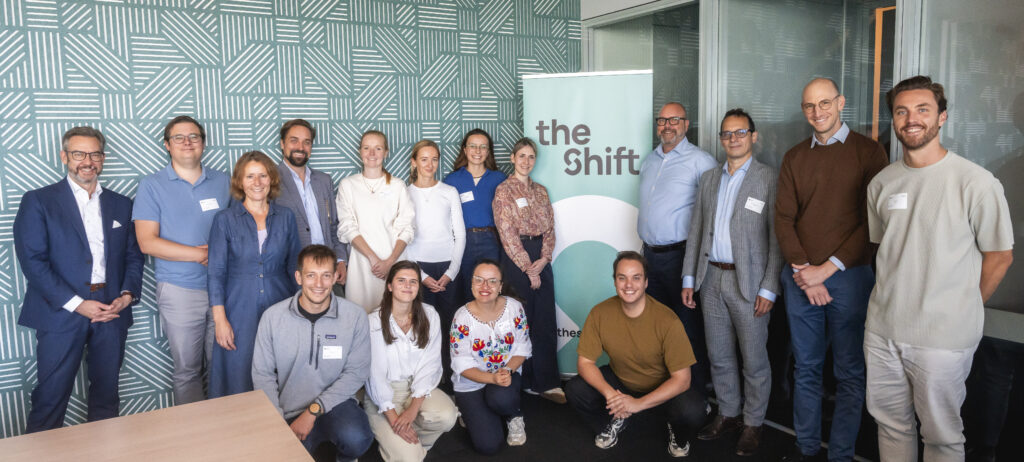
The timing could hardly have been better. What followed was not a traditional training course, but a series of open conversations with companies from entirely different sectors: telecoms, construction, packaging. Different realities, yet strikingly similar questions.
Within a small group, space emerged for honesty. About what is not yet working. About uncertainties. About how complex it can be to make progress. “You realise that everyone is running into the same challenges. That also takes some of the pressure off. There was something almost therapeutic about it. At the same time, concrete examples, familiar challenges and points of comparison help to drive internal conversations and support decision-making.”
What comes next
Today, imec is working on a concrete climate action plan for Scope 3. From a procurement perspective, a large part of this is already taking shape. But the journey remains dynamic. New data will continue to emerge. Suppliers will evolve further, or fall behind. Expectations from clients and regulation will only increase.
“The real tipping point? That’s when suppliers start to feel there are consequences to inaction. Preferably financial ones, as those tend to resonate most. Sustainability can no longer remain an abstract concept, it has to become an integral part of how we operate. That, to me, is the ideal scenario.”
Because ultimately, that is where the core of the challenge lies. Not in measurement alone. Not in reporting. But in mobilising what today still feels just out of reach.

Would you, like Ann-Sophie, take on the challenge of tackling the bulk of your emissions across your value chain?
The Shift breaks down your walls and brings together the unusual suspects around your table: peers from other sectors, leading companies, experts and policymakers. Together, we tackle your most complex sustainability challenges. Because together, you see more and achieve more. Ready to make your supply chain climate-proof?