Young Challengers

The Challengers zijn 40 jonge pioniers die de stem van hun generatie laten horen. Ze dagen ons team, projecten en netwerk uit met frisse ideeën en zetten die om in workshops, samenwerkingen en challenges. Zo ontwikkelen ze hun talenten en bouwen ze samen aan impactvolle projecten.

Biodiversity can’t be reduced to numbers, it’s shaped by choices

Embedding biodiversity within an organisation and its core activities takes focus, clear metrics and strong collaboration. In this conversation, Kristel Rouma explains how Coca-Cola Europacific Partners approaches biodiversity, and why this way of working is just as relevant for organisations far beyond the food sector.

Waterscape

Kristel Rouma is Senior Sustainability Manager at Coca-Cola Europacific Partners. Driven by a strong passion for nature and through her work on water, packaging and social impact, she helps shape a strategy that embeds Belgian biodiversity structurally within the company. Within the Community of Practice The Biodiversity Shift, she shares her insights and ambitions with other businesses.

Kristel Rouma

How does Coca-Cola Europacific Partners work on nature and biodiversity? And what actions are you exactly taking today?

Kristel: “Our strongest connection with nature is, of course, water. It is an essential ingredient in our products and a key resource in our production processes. That’s why we invest in projects that return the water we use back to nature, through wetland restoration and by managing water responsibly throughout our production operations.”

Packaging also plays a major role. We aim to collect and recycle everything we put on the market, so it does not end up in nature. Last year, 89% of bottles and cans in Belgium were collected via the blue bag system with Fost Plus. Through our suppliers, we are also working together on the transition to regenerative agriculture for ingredients such as oranges and sugar beets.

You are well known for your water projects. How does that translate into biodiversity?

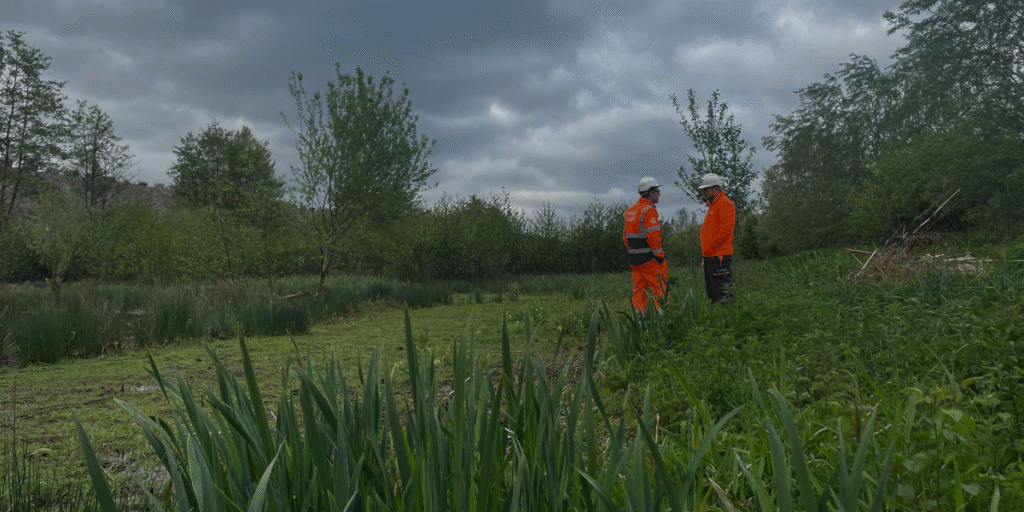
Kristel: “We have been working with Natuurpunt and Natagora on nature restoration projects for over ten years now, including the restoration of wetlands. Our goal is 100% water replenishment: for every litre of water we use, we aim to return an equivalent amount to nature through restoration projects, such as those in the Zwarte Beek Valley. Our sites in Ghent and Antwerp are located in areas with a high risk of water scarcity, which is why we set the bar even higher there. By retaining water for longer and maintaining groundwater levels, these areas also act as climate buffers. At the same time, species such as wetland birds, fish and dragonflies are once again given the opportunity to return to their natural habitats.”

“We also see other companies following our example, and we genuinely welcome that. The more businesses that get involved, the greater the impact.”

What are the biggest challenges to integrating biodiversity into your strategy?

Kristel: “Measuring impact is one of the biggest stumbling blocks. With water, we know exactly how much we use, but biodiversity is far more complex. How do you put the value of nature restoration into numbers? It’s precisely this complexity that we are exploring together with other companies in the Community of Practice of The Biodiversity Shift.

Beyond that, no company can do this on its own. Collaboration with NGOs and public authorities is essential. For nature restoration projects, land often first needs to be acquired or made available. That is primarily the role of the government, working together with NGOs that take on land management. From there, we can contribute through our expertise and by supporting concrete projects.

It remains a complex interplay between government, agriculture and the business community. Through The Shift, we can build bridges between these actors and take bigger steps together.

How does the current political climate affect your work?

Kristel: “Legislation on the environment and water quality is a key factor. We appreciate the efforts being made in Flanders to address water scarcity, but groundwater quality remains a challenge. We understand that the political landscape is complex, with many competing priorities and limited resources, yet we hope sufficient attention continues to be given to both climate and nature. This is crucial, not only for the environment, but also for businesses themselves if we want to secure a sustainable supply of raw materials.”

How far along are you with your nature strategy?

Kristel: “We are working at group level, across 31 countries, on a strategy to structurally embed biodiversity. We do this based on the TNFD methodology (Taskforce on Nature-related Financial Disclosures). Each country has its own specific needs. The situation in Belgium is very different from, say, the Philippines. We want to fully understand these local differences before defining global priorities. Our aim is to further develop our nature strategy in 2026.”

What has the community of practice brought you?

Kristel: “A lot. The programme creates space to share knowledge with companies grappling with similar questions. Everyone is looking for ways to make biodiversity tangible, and that happens in an open and highly constructive atmosphere.

What we find particularly valuable is that the community also enables real collaboration. One outcome of these exchanges is a partnership between Coca-Cola Europacific Partners, Delhaize and Natuurpunt on a joint project investing in nature engagement and experience.

We also learn a lot from each other’s approaches: how companies shape their strategies, how they create internal support, and how they work with partners. For us, that helps us understand how to translate our existing water projects into broader biodiversity goals.”

What tips do you have for companies looking to start with biodiversity?

Kristel: “Start from the intention to make positive impact. That has to be at the core of your company and supported by management. Then find the logical link with your activities. For us that is water. Keep it simple, set concrete goals and work with experts whenever possible. Don’t be put off by complexity or the fear of doing it wrong: you don’t have to do it alone.

I believe that change can also come from industry. Companies are often seen as the cause of certain problems, but just there we can show that things can be different, by working together and taking responsibility we can show that we are part of the solution.”

Is this for you?

With The Biodiversity Shift, you place nature restoration firmly on your company’s agenda, right at the heart of your operations. Step by step. Are you ready to move towards a robust biodiversity strategy, grounded in insight, collaboration and policy impact, and contribute to a nature-inclusive economy?

Overlay

More impact stories

Banks: unexpected allies of nature?

How can the financial sector help strengthen biodiversity? In this interview, Ronny Jongen, Senior Impact Manager, explains Triodos Bank‘s role in the shift towards nature-positive investing — and the challenges this brings for banks and their clients.

Lyreco

Lyreco, een privébedrijf sinds 1926, is de Europese leider en de derde grootste distributeur van werkplekproducten en -oplossingen wereldwijd. Onze missie is helder: pionier zijn in het duurzaam ontzorgen van elke werkplek, zodat medewerkers zich kunnen focussen op wat écht belangrijk is. Samen creëren we een duurzame en efficiënte werkomgeving. Want bij Lyreco leveren we niet alleen producten, we zorgen voor een goede werkdag.

Koffies De Draak

Sinds 1864 staat Koffies De Draak garant voor uitmuntende koffie. De zoektocht naar de lekkerste koffiesoorten, werken aan eerlijke producten in een omgeving van kwaliteit en ambacht: daar zijn we op gebrand. Bovendien is De Draak een onderneming met een sterk doorgedreven sociaalecologisch engagement. Respect voor mens en natuur staat bij ons centraal. We streven dan ook blijvend naar transparantie, eenvoud en kwaliteit. 

Why the future of food might just look like pizza

“If the food of the future isn’t delicious, it simply won’t work.” Food after The Shift. An interview with Alice Lemesle, Senior Sustainability Manager at Danone Benelux.

Production site Danone

3D-printed food, algae-based yoghurts and edible packaging… The food sector is on the brink of major change, much of it driven by the shift towards more sustainable ways of producing and consuming food. As Senior Sustainability Manager at Danone Benelux, Alice Lemesle finds herself right at the heart of these developments, and she is genuinely excited about what lies ahead: “The food of the future can’t just be healthy, seasonal and sustainable,” she says. “Above all, it has to be incredibly tasty.”

Alice Lemesle Danone Benelux

“The real challenge,” Lemesle says, “is finding the sweet spot between health benefits, climate benefits and social acceptance. Once you get that right, a new product actually stands a chance. You won’t achieve climate or biodiversity goals if people feel they’re the ones footing the bill. The same goes for taste,” she adds. “A new product simply has to be delicious. Better than the one it replaces. Food is, and always will be, an emotional thing.”

When asked whether Danone has already found that sweet spot, Lemesle pauses for a moment. “Of course there’s Alpro, which plays a key role within our portfolio. What’s great about Alpro is that you don’t have to be vegan to love the brand. It’s for anyone who wants to eat more consciously. But we’re also trying to extend that plant-based logic to less visible segments, such as medical nutrition and tube feeding. There, we’re seeing that some plant-based or hybrid products not only have a lower footprint, but are also better tolerated by patients. In medical nutrition, there’s no room for compromise when it comes to health. So when a more sustainable option also performs better medically, that’s truly remarkable, especially if the patient experience remains the same. That’s a win-win-win situation. And that’s exactly the sweet spot I was talking about.”

Sustainability doesn’t just happen in R&D labs

Danone is deliberately using food as a lever for better health. It recently opened the One Biome Lab in Paris, which focuses on the role of the microbiome and gut health. “In that lab, we explore how we can develop products that genuinely contribute to people’s health,” Alice explains. “Research and innovation are crucial for the future of food – that’s naturally what most people think of first. But sustainability doesn’t just take place in R&D labs or offices. It happens, above all, out on the land.”

Susatinable 3D food

In Belgium, Danone works closely with dairy farmers on regenerative agriculture. The focus is on improving soil health, increasing biodiversity, enhancing animal welfare and reducing emissions. “For instance, with the help of a specific feed additive, methane emissions from cows can be reduced by up to forty per cent,” Lemesle explains. “That’s genuinely a huge impact. Precision farming also plays an important role. Supported by technologies such as satellite imagery and sensors, it gives us a powerful lever to keep farmland productive and healthy in the long term. I see a lot of potential there.”

New stories

“But that’s still not enough,” Alice says. “It’s also about creating new stories in society. You can work extremely hard on your own portfolio, but if social norms don’t shift alongside it, you eventually hit a ceiling,” she explains. “That’s why Danone takes part in initiatives such as the Green Deal Protein Shift, and why we’re very active in networks like The Shift. These are spaces where companies, organisations and other actors share experiences, failures and successes. Sometimes we support smaller businesses with our knowledge, but just as often we learn from them. It’s a two-way exchange. No one has all the answers.”

One area where tensions around safety, environmental impact and cost all come together is packaging. “It’s probably the most complex file of all,” she admits. “Packaging has to keep food safe, remain affordable and work within existing logistics – while ideally also being reusable. There’s a lot of work being done on edible packaging, which is fascinating. But for me, the first step is the obvious one: everything that comes onto the market should be recyclable. Unnecessary materials need to go, and recycled materials should be used wherever possible.
The next question is how we can replace single-use packaging as much as possible with reusable systems, or with packaging that truly creates no waste.”

She shares an example of a pilot project using reusable yoghurt pots within a closed-loop system. The pots were returned, washed and refilled. “Conceptually, it made perfect sense,” she says. “But in practice, there simply wasn’t enough washing capacity nearby. The pots had to be transported several hundred kilometres to be cleaned, which from an environmental perspective was obviously far from ideal. It taught us that no matter how large a company is, this isn’t something you can roll out on your own. You need local infrastructure, retailers willing to play their part, and consumers who are prepared to participate.”

“And it’s not only about revolutionary new ideas,” Alice continues. “Not long ago, we removed the outer sleeve from Actimel packaging. That’s only a few tenths of a gram per pack. But at the scale Danone operates, it saves tonnes of plastic every year. The impact you can make through changes like that is exactly what makes it so enjoyable to work here.”

Lemesle has now been working for the food giant for six years. “During my master’s in sustainable development, I did an internship at Danone. In a way, I never really left,” she says. “It felt as though everything naturally led me in that direction. I started out at Danone in France, but an assignment for Alpro eventually brought me to Belgium. My family is from the Lille region, so Belgium wasn’t entirely unfamiliar territory.”

Algae are the future

But back to the food of the future: where does Alice Lemesle see the greatest potential? “As you can probably tell from all my talking, that’s not a straightforward question to answer,” she says. “There are always many different factors to take into account. But if I really had to point to one area, I’d say algae as a protein source. Personally, I find that a very interesting avenue. Algae are genuinely promising, once again because they have the potential to hit that sweet spot. In principle, they’re relatively inexpensive to produce. The technology is still quite costly at the moment because we’re only at the beginning, but that will change. On top of that, algae are rich in nutrients, low in CO₂ emissions and, importantly, foods made from algae are relatively easy to accept socially. The versatility of algae is remarkable. You can create textures and flavours that come very close to familiar products. We’re really only just getting started.”

Alice is quick to add a caveat: when it comes to predicting the future of food, she shouldn’t be taken too seriously.
“I’m not an expert in forecasting,” she says. “I’m not a futurist or a product developer. I’m a sustainability manager. But if you ask me what the food of the future is, I simply think of pizza.”

“Food has to remain a source of pleasure. My ideal future is one where food is healthy, seasonal, as local as makes sense, and wrapped in minimal, smart packaging. And above all, it has to be really delicious. That’s where the pizza comes in. I picture a base made from wholegrain flour, perhaps enriched with algae or other protein-rich ingredients. A rich tomato sauce from flavourful, seasonal tomatoes. Vegetables like pumpkin or mushrooms in autumn. Regional, low-impact cheese made with milk from regenerative farming. And genuinely good plant-based ham – high in protein and low in CO₂. That’s what I miss most as a vegetarian: truly tasty ham. Add a few olives on top, and it’s done. Sorry it’s not more futuristic than that,” she laughs. “But food simply has to be delicious. Otherwise, it doesn’t stand a chance.”

“Pleasure is simply a key factor on the path to sustainability, one we mustn’t lose sight of. If something tastes better or feels more enjoyable and it’s more sustainable, then it has real potential. The same applies to how business leaders approach sustainability. If it’s only about rules and restrictions, the transition will never truly take off. What you need is a bit of courage, inspiration, collaboration, and a different compass. As long as success is measured solely in profit, sustainable choices will always feel like an ‘extra’.”

“We need to dare to use different indicators of progress: wellbeing within the company, social impact, ecological resilience. And the joy of exploring what’s possible, the curiosity to see what could be. If we throw those ingredients together and bake ourselves a pizza with them, we’ll be absolutely fine.”

Would you like to join Alice in building a more sustainable economy?

The Shift breaks down barriers and gathers the unusual suspects around the table: colleagues from other sectors, leading companies, experts and policymakers. Together we tackle your most complex sustainability challenges. Because together you can see and do more.

Overlay

Biodiversity in every link

At Vandemoortele, Sustainability Officer Laura Iacobelli works on a chain that respects nature. No loose initiatives, but a well thought-out strategy that connects business and biodiversity.

As Sustainability Officer at Vandemoortele, Laura Iacobelli focuses on biodiversity, communication around their sustainability strategy and collaboration with procurement for the sustainability of raw materials such as palm oil and soy. She closely follows legislation and drafts sustainability policies. Her passion for sustainability – rooted in the natural sciences – drives her to reconcile nature and business.

What is the impact of Vandemoortele’s activities on nature and biodiversity?

Vandemoortele is a food company with two major business lines: plant-based food solutions such as fats and oils, and bakery products. We rely heavily on biodiversity for key raw materials such as palm oil, soybean oil, vegetable oils and cocoa. This dependence runs through our entire chain – from the availability of raw materials to the use of water in our recipes. Healthy ecosystems are essential to our production process. Without a wide diversity of pollinators such as bees, there are no flowers. And without flowers, there are no seeds, and therefore no oil production.

What actions does Vandemoortele take to protect nature on and around its sites?

We are active both at our production sites and in the areas where we source raw materials. In Malaysia, we are collaborating with the Earthworm Foundation in a multi-actor landscape project involving social responsibility, deforestation and coexistence with elephants. In France, we are working with our flower suppliers on a regenerative agriculture project for wheat. Locally, we are reducing our impact on biodiversity through water management measures and providing safe nesting sites for falcons at our French factory. We also use tools such as the WWF Risk Filter to evaluate the impact of our sites. We want to embed biodiversity in our processes in a more structural way.

What are the biggest challenges in developing a biodiversity strategy?

One of the main challenges is to translate the bigger picture into concrete actions. It is difficult to determine exactly which interventions are most impactful, and to strike the right balance between thorough analysis and pragmatic implementation. We often waver between a comprehensive approach such as the Science Based Targets for Nature, or rather an action-oriented strategy with immediate steps. It remains a balancing act between available resources – in time and budget – and expected impact

How does The Biodiversity Shift help move your strategy around nature forward?

We joined the learning network to deepen our understanding of biodiversity and validate our existing efforts. Because of my background in the natural sciences, I felt strongly about the initiative. The program provided a wide range of insights – from scientific approaches to simple but impactful actions – and emphasized that biodiversity is a holistic issue. These insights, along with stakeholder consultations, led us to include biodiversity as a separate material theme in our new sustainability strategy, with dedicated attention and resources.

What are your plans in terms of biodiversity in the future?

We want to expand our field projects – like the one in Malaysia or around wheat – to other raw materials and ingredients. In addition, we plan a deeper analysis of the impact in our value chain to determine the most effective actions. We want to move from stand-alone projects to a more integrated, impact-driven approach across all our activities.

What tips do you have for other companies looking to commit to biodiversity and nature?

Start now, regardless of where you are in your sustainability story. Participate in learning initiatives like webinars and learning networks to find a starting point, and use tools like the WWF Risk Filter for initial analysis. Develop action plans with initiatives directly linked to your core business, rather than stand-alone projects. Awareness is crucial – make sure everyone in your organization understands how their actions affect biodiversity.

forest river

More impact stories

Carmeuse backs biodiversity

What if biodiversity is the key to economic stability and innovation? Carmeuse, producer of lime and construction materials, shows us how small steps lead to ambitious projects.

The Nest Family Office

The Nest is a Belgian family office investing in the future of food. We are driven to create a healthy and fair world for generations to come. We partner with entrepreneurs in food and agriculture who are solving some of the biggest food challenges on the planet. Through a disciplined and pragmatic approach, we source the most impactful companies and help them grow.

the nest logo

AxHA

AxHA helps organizations to increase their positive impact on people and the planet. Their consultants work on three levels: they influence policy through public affairs, supervise impact projects and collaborations, and conduct research on ESG logic to understand and strengthen the impact of organizations and sectors.

axha logo

Maison Dandoy

Since 1829, Maison Dandoy has been a Brussels family business with a passion for tradition. We make real, local food under fair conditions. Our biscuits are generous and tasty. With craftsmanship and innovation, we strive for a fully regenerative and sustainable model, biscuit by biscuit.

maison dandoy logo

deSter

deSter is a leading designer and manufacturer of innovative, sustainable food packaging and service concepts for aviation, hospitality and food service. With more than 40 years of experience and production locations in Belgium, the US and Thailand, they serve customers worldwide.

dester logo