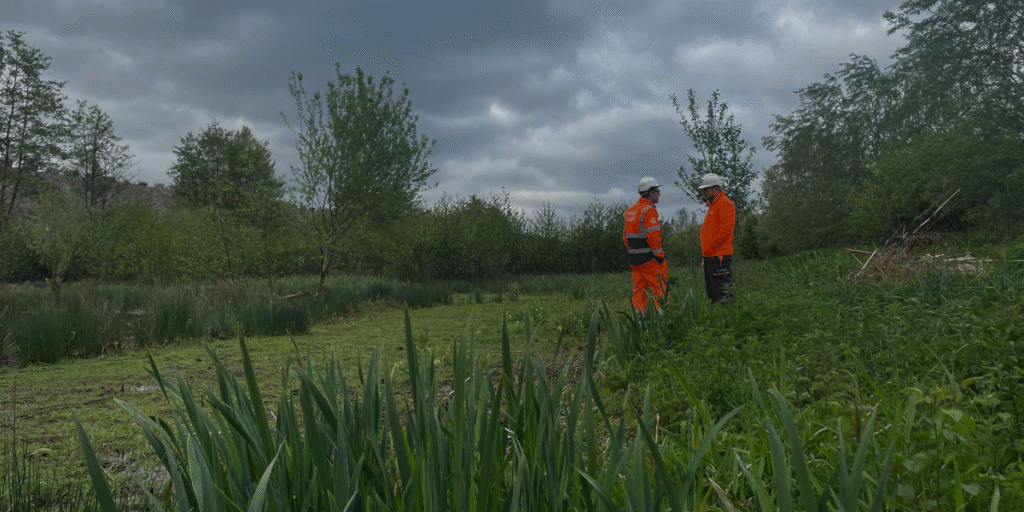
Banks: unexpected allies of nature?

How can the financial sector help strengthen biodiversity? In this interview, Ronny Jongen, Senior Impact Manager, explains Triodos Bank‘s role in the shift towards nature-positive investing — and the challenges this brings for banks and their clients.

Ronny Jongen is Senior Impact Manager at Triodos Bank and has been active in sustainable finance for 17 years. In his role in property and lending, he looks at how banks can promote biodiversity — not just as a risk, but as an opportunity for nature restoration and societal value.

As a bank, you are strongly committed to biodiversity and nature. How does that focus translate into your way of working and investing?

Ronny: Nature and biodiversity have been part of Triodos Bank’s DNA since our founding in 1980. It’s a logical extension of our mission: we don’t just want to finance change, we want to change the financial world itself. Finance change, change finance. So with every loan they look at mission fit: what is the cultural, social or ecological added value of the project?

Our goal is to invest 500 million euros in nature-based solutions by 2030. That ranges from nature restoration and conservation to regenerative agriculture. Frankly, this is also trial and error for us, but we learn by doing. After all, we are not biodiversity specialists, but we want to become specialists in financing biodiversity, by testing out pilot projects and tools, and by making the topic discussable with clients.


Triodos supports The Biodiversity Shift as a flagship partner. Why did you feel it was important to contribute to this learning network?

Ronny: Because we want not only a theoretical framework, but also practical experience. We find that many organizations and companies struggle with similar questions: how do you make actions around biodiversity tangible and how do you scale them up within a business context? How do you get your management on board?

The network brings together people working in the field. Everyone comes with the intention of learning from each other and seeing how others are doing it. For us, that was the main reason for joining. It helps to understand what our clients or partners are up against, and how we can better support them in that.


What challenges surface when guiding clients toward nature positivity?

Ronny: We have a responsibility as a bank to put savers’ money to good use, but what exactly “good” means is not always clear-cut and sometimes open to debate. We therefore need clear metrics to measure, evaluate and report our impact. It remains a challenge to find projects that are both ecologically and financially sustainable. We want to invest 500 million euros in nature restoration, but the sector needs billions.

At the same time, we are exploring how we can better integrate biodiversity into our decision-making, not only in lending, but also in investments and our own building management. We are working on KPIs to embed that structurally.

In addition, biodiversity projects often have a long-term impact, while financing is short-term. As a result, it is not always easy to convince customers and to fit these projects into classic credit models. Moreover, the benefits are collective, but the costs are individual. Finding that balance is the biggest challenge.

Can you give an example of such a project?

Ronny: We mainly look for projects where we can make impact at scale. Here we support Natuurpunt and Natagora in their operations, as for example in the introduction of nature-based solutions in the Park of L’Entre-Sambre-et-Meuse, one of the youngest national parks in Belgium.

But the bulk of our projects are in the United Kingdom, Spain and France. In the United Kingdom, we fund, among others Oxygen Conservationan organization that buys and restores large tracts of land by restoring forests, protecting peatlands and encouraging nature tourism. Together with Triodos, it developed a financing model where repayment is linked to proceeds from nature restoration.

These are small-scale but meaningful examples. They show that nature restoration can also be economically feasible while creating social value.


Do you see enough willingness among customers to take that step?

Ronny: In real estate, you see two types: the convinced, and those who know little about the subject. The former are often already in programs such as The Biodiversity Shift. The second group sometimes does not realize that investing in sustainability also pays off economically. Sustainable buildings have less vacancy, higher value and attract young talent more easily.

We try to support them in this, by going further in loan-to-value and by setting clear, minimum engagement conditions: if promised sustainability investments are not implemented, we do not step into the project.

What about within domains other than real estate?

Ronny: In the agricultural sector, it’s also moving. We expect more concrete guidelines for that field by 2026. Even in the film sector, we are asking questions about sustainability impact: can you film locally, use less transportation, provide vegetarian catering? Small things, but they make people think.

More impact stories

Carmeuse backs biodiversity

What if biodiversity is the key to economic stability and innovation? Carmeuse, producer of lime and construction materials, shows us how small steps lead to ambitious projects.

With The Biodiversity Shift, you get nature restoration on your business agenda, right to the core of your operations. One step at a time. Are you ready to shift to a solid biodiversity strategy with insights, collaboration and policy impact for a nature-inclusive economy?


Overlay

At Degroof Petercam, nature gets a place in investment policy

Jo Wuytack (Degroof Petercam) is working on an investment strategy that anchors biodiversity and links economic value to responsibility for nature.

As Group Sustainability Manager at Degroof Petercam, Jo Wuytack is something of an “influencer” of their sustainability story. He coordinates sustainability efforts across the company: from private banking to asset management, corporate finance and support services, in several countries. What motivates him? Working daily with passionate people and pushing the agenda forward to make real impact.

What impact does Degroof Petercam have on biodiversity and nature?

For Degroof Petercam, the main biodiversity impacts – and also the biggest levers – are almost exclusively in our scope 3 activities: the investments we manage for our clients. As an asset manager, we consider it essential to inform our clients and to include biodiversity in our analyses and discussions, given its major impact on the economy.

What actions is Degroof Petercam taking to protect and enhance nature on its own sites?

Before our participation in the learning network, biodiversity was mostly discussed informally, without a clear plan of action. Today, we participate in Nature Action 100, an initiative where investors encourage companies to address biodiversity issues. Our approach is two-track: on the one hand, we aim to raise clients’ awareness of the risks and opportunities presented by biodiversity; on the other, we continue to actively encourage companies we invest in to take action.

What are the biggest challenges in integrating biodiversity into your business model?

Data. Finding reliable, accessible data and useful indicators is not obvious. Biodiversity is a very broad topic and cannot be captured in one or two parameters. For many companies, terms such as “endangered species” or “water consumption” remain abstract concepts, making it difficult to prioritize them. This makes the topic very complex, and sometimes polarizing.

How did The Shift’s community of practice help you take steps forward?

We entered the program with an awareness of the importance of biodiversity, but without a concrete starting point. The sessions provided us with a clear overview of emerging frameworks as well as the chance to learn from others with similar questions. The informal approach – sharing a coffee and hearing how others approach it – was very inspiring. It gave us insight and the desire to go further.

What are your plans around biodiversity in the near future?

Since our participation in the Action Lab, our asset management arm, DPAM, has committed to be an early adopter of theTaskforce on Nature-related Financial Disclosures ( TNFD) framework. By 2025, we will report on how biodiversity affects our clients’ assets. We have chosen a data provider that focuses specifically on biodiversity and are currently conducting analyses to gather insights. Based on those results, we will align our actions with the Kunming-Montreal Global Biodiversity Framework. What started at DPAM will also inspire other parts of the group. It is challenging, but the momentum is there.

What tips do you have for other companies looking to get started around biodiversity?

Start by identifying your current situation. In finance, this means identifying data providers. In industrial sectors, it’s best to start with life-cycle analyses. From there you can take small, concrete steps. And above all: seek dialogue with other sectors and colleagues. People really enjoy sharing their insights. This is not about secret recipes. Biodiversity is a challenge for all of humanity, not just your company. Collaboration is crucial.

More impact stories

Carmeuse backs biodiversity

What if biodiversity is the key to economic stability and innovation? Carmeuse, producer of lime and construction materials, shows us how small steps lead to ambitious projects.

With The Biodiversity Shift, you get nature restoration on your business agenda, right to the core of your operations. One step at a time. Are you ready to shift to a solid biodiversity strategy with insights, collaboration and policy impact for a nature-inclusive economy?

Overlay

Helios Foundation

Helios Foundation promotes a carbon-neutral and mentally resilient Belgium. Through multi-million dollar funds, partnerships with the King Baudouin Foundation, universities and companies, it supports pioneering projects that reduce emissions and strengthen well-being at work. Innovation, integrity and measurable impact are central to her approach.

helios logo

Align

Align is a law firm that assists financial institutions and corporations with complex legal and regulatory issues. We specialise in ESG & sustainability, banking & finance, and data protection. Our advice is pragmatic, clear and tailor-made – without jargon or unworkable solutions.

align logo

Qover

Qover is an insurtech that helps businesses deliver fluid, technology-driven insurance experiences. With our modular platform, we provide a global safety net that supports people to live life to the fullest. We serve millions of users in 32 European countries, along with partners like Revolut, Mastercard, and BMW.

qover logo

Avertim

Avertim is a consultancy group specializing in innovation and management. We build a bridge between strategy and execution, translate strategies into concrete projects and ensure alignment between business, technology and management.

avertim logo

Leaseline

We specialize in leasing with tailor-made solutions for the medical, agricultural, mobility, industrial and equipment sectors in the Benelux. At LeaseLine, we believe that everyone has the right to happiness at work, personal growth and financial opportunities. We want to strengthen people and companies with every service.

leaseline logo

Impact Finance Belgium

Impact Finance Belgium is a member association that aims to increase the share of impact and sustainable capital in Belgium. IFB unites capital providers who strive for measurable impact on people and the planet. They welcome all stakeholders from the impact finance ecosystem, such as foundations, impact investors, and traditional funders.

impact finance logo

Castior

Castior is an active investor that supports entrepreneurs who are making the shift to a more sustainable economy. Our investment themes are Health, Circularity and Sustainable Infrastructure.

castior logo

SPDG

SPDG est le véhicule d’investissement de la famille Périer-D’Ieteren et un actionnaire actif du groupe D’Ieteren, certifié B Corp. Via SPDG Ventures, il investit dans la croissance durable, la transition énergétique, la mobilité, les infrastructures circulaires et la santé numérique. Avec des financements et un accompagnement entrepreneurial, SPDG accélère l’adoption de solutions pour améliorer la vie des citoyens.

spdg logo